Sunday, 1 November 2026

Managing Brake Heat and Cooling Trade-offs in Grand Prix Racing

By: Pete Davidson On: 02:56
  • Share The Gag
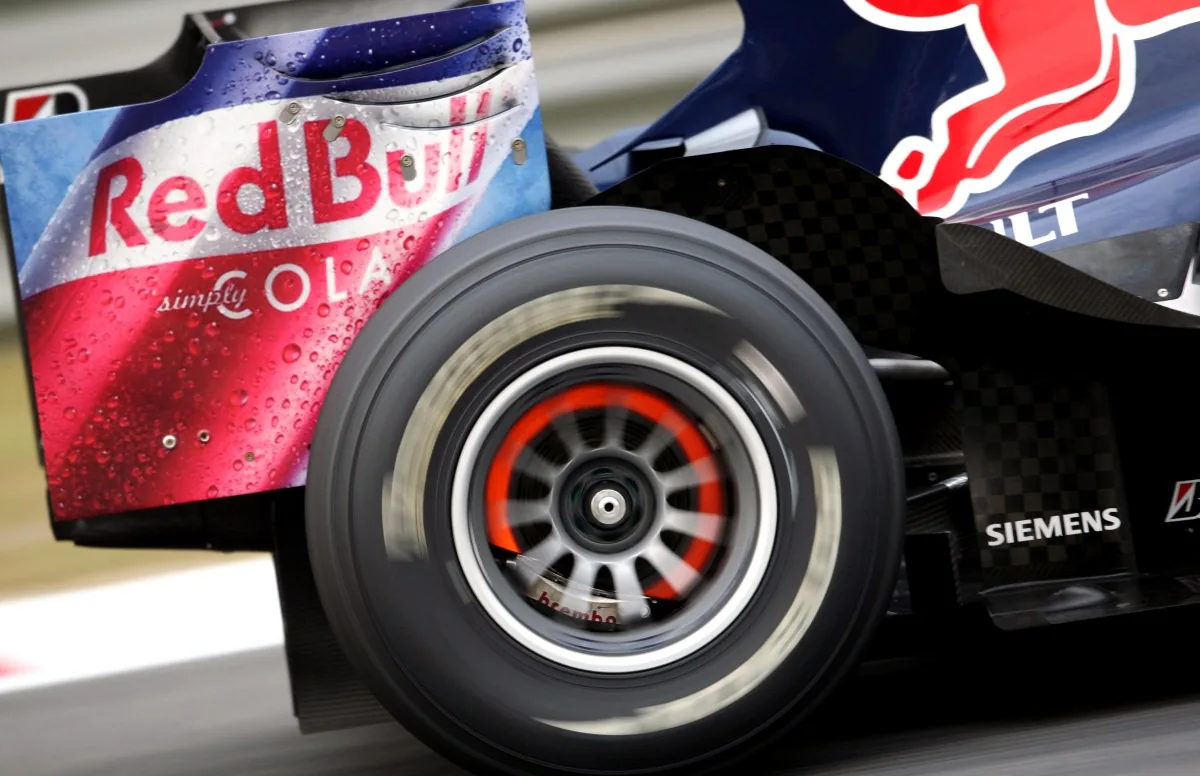
  • Close-up of a Red Bull-liveried Formula 1 car’s wheel, showing a red-orange glowing brake disc behind the blurred spokes.

    The Origin of Glowing Discs

    Spectators watching cars decelerate into heavy braking zones often notice incandescent wheel hubs. The question of Why F1 brake discs glow red comes down to extreme thermal generation, where fierce friction between the brake pads and the carbon-carbon discs heats the surface sufficiently to emit visible light. While peak disc temperatures have historically been reported to exceed 1,200°C under severe conditions, glowing can start at lower thresholds, such as around 600°C in endurance racing comparisons, becoming more prominent as temperatures rise above 1,000°C.

    Balancing Temperature Limits and Wear

    A visible glow does not indicate an emergency or imminent component failure on its own. Racing brakes perform poorly when cold and require high temperatures to work effectively, so teams cannot aim for maximum cooling. However, when heat dissipation fails to match prolonged demands, excessive temperatures accelerate disc and pad wear while reducing braking efficiency.

    Ventilation holes drilled directly through the discs help shed this intense heat. From a tactical perspective, managing that cooling airflow represents an ongoing compromise: opening up ventilation ducts preserves stopping power and prevents accelerated wear across a stint, but teams must balance those cooling requirements against the operating window necessary for the carbon material to bite effectively.

    Official reference: Formula 1 official news and results.
    When Race Tactics Cross Into Scandal: What History Shows About Strategic Manipulation

    By: Pete Davidson On: 01:15
  • Share The Gag
  • Three dark helmet symbols numbered 1, 2 and 3 beside the text “Top 10 Most Controversial F1 Drivers of All Time (2025 Edition)” on a cream background.

    The line between aggressive tactics and regulatory breaches

    In Formula 1, pit-wall strategies routinely seek to exploit safety car periods, track position, and regulatory boundaries to gain an edge over rivals. However, motorsport history reveals stark trade-offs when competitive aggression or tactical planning moves past acceptable limits into deliberate disruption. Compilations examining driver reputations, such as GamerKoala's Top 10 Most Controversial F1 Drivers of All Time (2025 Edition), reflect how actions spanning decades continue to define public perceptions of competitive fairness.

    A clear example of this dynamic appeared in the 2008 Singapore Grand Prix, where Renault instructed Nelson Piquet Jr. to crash deliberately. The resulting safety car period directly assisted Fernando Alonso in securing a race victory. While Alonso benefited from the tactical timing of the pit stops, sources note that capitalizing on that sequence does not establish that he personally orchestrated or possessed advance knowledge of the plot, illustrating how team-level decisions can complicate the reputations of the drivers who drive for them.

    Championship stakes and deliberate track position battles

    Title-deciding races have also tested the boundary between defensive track position and unsportsmanlike interference. In the 1997 season finale, Michael Schumacher faced championship disqualification following a collision with Jacques Villeneuve that commentators and officials judged to be intentional. Similarly, the 1989 and 1990 Japanese Grands Prix featured decisive collisions between Ayrton Senna and Alain Prost, with Senna later acknowledging that their 1990 crash was deliberate retaliation.

    Whether involving safety car timing, extreme defensive moves, or protests, these episodes demonstrate that while radical strategies can influence a single grand prix or championship outcome, they carry severe regulatory and reputational consequences that linger far beyond race day.

    Official reference: Formula 1 official news and results.